
Why bought lists return so little
A database sold to anybody has already been contacted by everybody. The companies in it have received the same email from dozens of suppliers, and they have learned to ignore it.
There is also a problem of fit. The filters available — sector, size, area — are crude compared with what you actually need. Two companies with the same industry code and the same headcount can have opposite needs.
Finally the data ages. People change roles, companies close sites, addresses stop working. A list frozen a year ago contains a proportion of noise that nobody declares to you.
Start from the ideal client, not from the market
The right question is not “how many companies can I contact”, but “which companies am I already useful to”. The answer is found by looking at the clients you have: which are the most profitable, which come back, which cause the fewest problems.
From there the real criteria emerge, and they almost never coincide with a database’s filters. They might be the organisational model, whether or not there is a dedicated person in-house, or the stage the company is at.
Exclusion criteria matter just as much: who you do not want as a client. Defining them in advance stops the list filling up with companies that would waste your time.
- Look at your best current clients, not at the market in the abstract
- Look for the real criteria, not the ones the database offers
- Write down who to exclude, and why
- Define what makes a company worth contacting now
The public signals that actually say something
What distinguishes a useful list is the presence of a reason. It is not enough that the company exists and is in the right sector: you need a signal that explains why it makes sense to talk to them now.
Useful signals are public and verifiable: a website recently rebuilt or untouched for years, a new site opening, a job advert that reveals a direction, presence or absence on a channel that matters in that market.
The working rule is simple: every entry on the list has to carry the source it came from. If a row has no source anybody can check, it is not information but supposition, and it shows on a phone call.
What a well-made list looks like
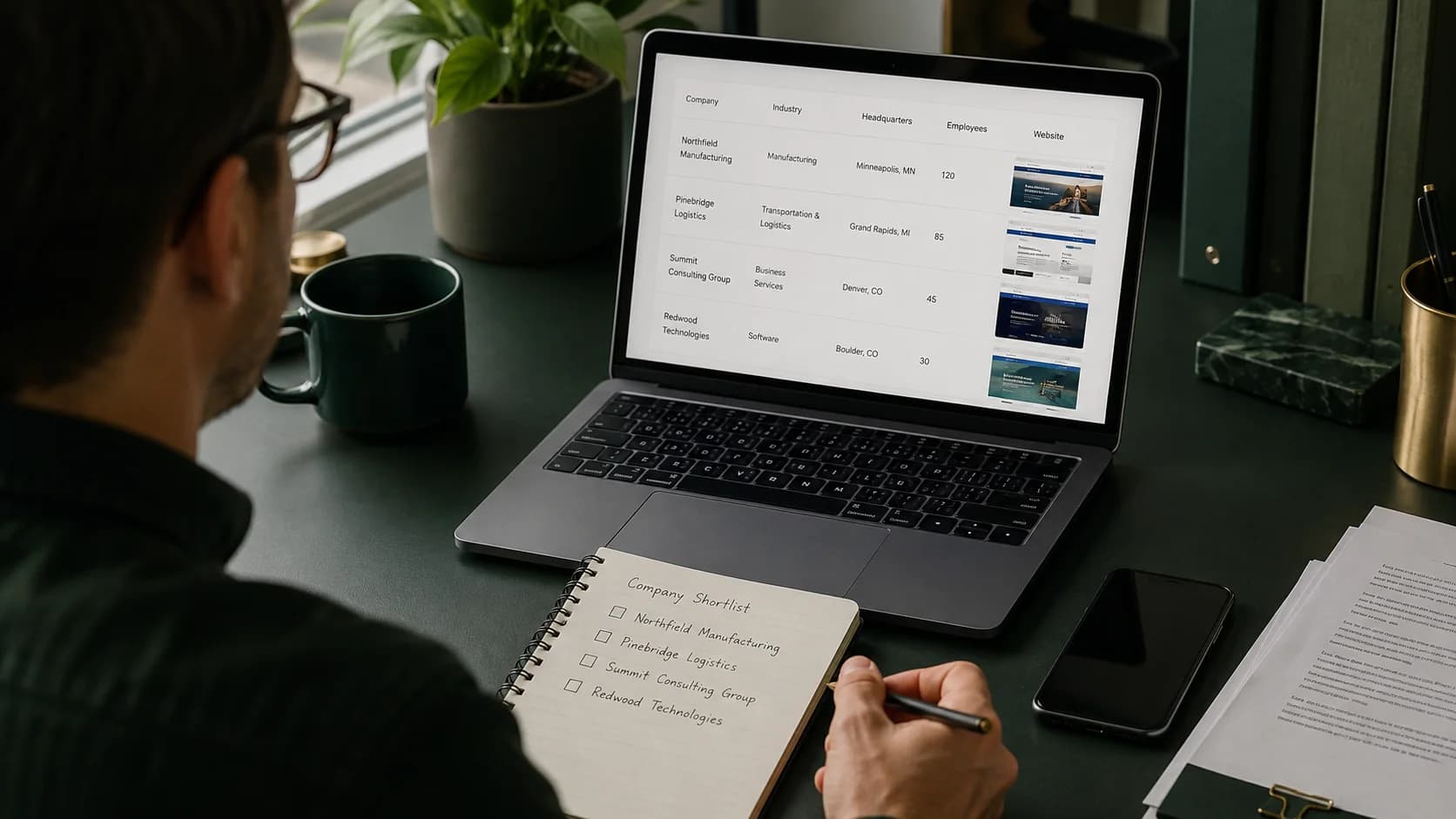
A useful list is short and ordered. Thirty verified companies are worth more than three thousand rows nobody will ever look at, because thirty can genuinely be worked.
Every entry should carry three things: who the company is, why it fits your ideal client, and where the information came from. With those three, whoever picks up the phone already knows what to say.
Duplicates, off-target companies and those whose data is not solid enough have to be removed. A clean list is shorter, and that is fine.
- A few verified companies instead of many raw rows
- For each one: the reason and a source anybody can check
- Duplicates and off-target profiles removed
- A priority order, not a flat directory
Making contact: what the rules say
The fact that an address is public does not automatically make it usable for any purpose. In business-to-business commercial contact there is some room, but it has to be assessed case by case, together with the lawful basis you are relying on.
In practice: inform whoever you contact, make objecting easy, and do not reuse the data for purposes other than those you declared. And keep a record of where the data was gathered, which is useful to you before it is useful to any authority.
For that reason research and contact should be kept separate. Building a qualified list is analytical work; contacting it is a separate activity that has to be set up carefully.
Frequently asked questions
Why not simply buy a database?
Because it answers the wrong question: it tells you which companies exist, not which ones have a reason to listen to you now. It has also been sold to your competitors, and the data ages quickly.
How many companies do you need to start?
A few worked properly return more than many ignored. A first cycle on around thirty verified companies lets you see whether the client profile is the right one before widening.
Does the research include sending the messages?
They are two different activities. The research produces a qualified list with sources and reasons; making contact has its own rules, including regulatory ones, and has to be set up separately.
Can appointments be guaranteed?
No. What can be guaranteed is the agreed research and verification work. Appointments also depend on the offer, the message and the sales process, none of which are in the hands of whoever builds the list.
How do you check the data is reliable?
By carrying, for every entry, the public source it came from, so it can be checked. A row without a source anybody can consult should be treated as a supposition, not as information.
This is how we work on it
- B2B prospectingThe Pilot: up to 30 verified companies, with sources and priorities.
- Cleaning companiesA sector where the list is built by area and by type of building.
Sources
- Regulation (EU) 2016/679, GDPR — The official text on EUR-Lex: legitimate interest, the privacy notice and the right to object.
- Italian public opt-out register for marketing calls — To be checked before any promotional phone contact in Italy.
- Italian Data Protection Authority — The authority that supervises unsolicited commercial contact.
Back to SWA Journal